
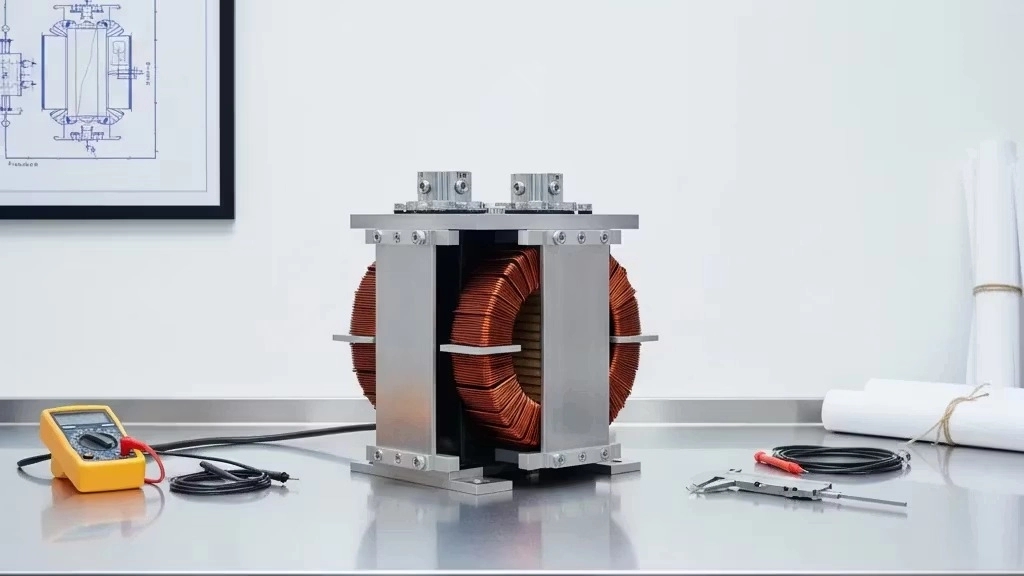
Beyond a tag: what does "formal confirmation" mean in the transition of industrial flow?
Passage of Standard Seven Readers: Key Exams for official approval
1. Temperature Increase Test (TEMPERATURE-RISE Test)
- Objective: Ensuring that the trans is not too hot during continuous work under the nominal load. In industrial environments, CTs often work closely and close to their nominal current.
- Method: Nominal current is constantly passed through the initial and the temperature of different parts of the trans is measured until the thermal stability. Increasing temperature should not exceed the permissible limits defined in the standard thermal class used.
- Importance: Excessive heat greatly reduces insulation life and can lead to premature electrical failure. Success in this test shows the design of the industrial flow transmitting with optimal thermal management.
2. The Short-Current Test (Short-Time Current Test)
- Objective: This is one of the most violent and important tests. Its purpose is to examine the transition capability to tolerate the enormous dynamic and thermal forces caused by a severe short circuit in the network.
- Method: Tens of times the nominal current (usually for 1 or 3 seconds) is applied to the trans. Transpas should withstand any mechanical damage (deformation of coils, insulation breaks) or thermal (melting wires). An industrial current transit design with official approval must be able to survive this test.
3. Lightning Impulse Voltage Test)
- Aim: Simulation of lightning into power lines and ensuring that the transmission system can withstand this sudden and severe voltage without failure.
- Method: A very high voltage pulse with standard waveform (known as 1.2/50 microtania). It confirms an insulation against natural disasters and keyboards in the network and is critical to any industrial trans -flow design installed in power posts.
4. Accuracy test (ACCURACY Test)
- Aim: Confirmation that the transmission ratio and the angle angle error of the transducer are within the defined class for its accuracy (eg Class 0.2s for measurement or 5p10 for protection).
- Method: Trans -tested under different loads and different percentage of the nominal current. Confirms the transistor. The measurement error can result in inaccurate and financial loss and the protection error endangers the entire system's safety.
Arya Birch Converter Methodology: Engineered Design for official approval
Phase I: Standard -based design and advanced simulation
- Beyond the Minimum: We do not design our products solely to meet the minimum requirements, but with the high confidence margin. This approach greatly enhances the chances of success in type tests.
- Simulation Software: Prior to the first sample, the design of the industrial current is simulated in the limited element software (Fea). Electric field distribution, thermal stresses and mechanical forces are modeled and optimized under short circuit conditions.
Phase Two: Obsessive -compulsive selection of raw materials
- Magnetic core: We use the best nanoblorerin silicone steel grade or nickel-iron alloys for high precision measurement cores and high saturated steels for protective cores to ensure optimum performance in the accuracy and short circuit test.
- Short -circuit current tolerance shows a perfect function.
- Epoxy resin (for resin CTs): In industrial trans -resin transit design, epoxy resin formulations with extremely mechanical and mechanical properties are processed to be processed by the infusion process (APG).
Phase 3: Strict quality control during production and pre -test
- Equipped Laboratory: Arya Birch Converter has a quality control laboratory that is capable of performing many routine tests and some type of internal tests. Each industrial current transistor is subject to precision pre -tests within the company before being submitted to the reference laboratory. This minimizes the risk of failure in the final test.
- Documentation and Tracking Ability: All production steps, from the entry of raw materials to the final test, are completely documented to ensure quality and full tracking stability.
Phase 4: Cooperation with official authorities for certification
After making sure the design is successful and the prototype, the product is sent to reputable and independent laboratories for final type tests. The certificate issued by these references is the final formal approval of the quality and performance of our industrial transnational design that we proudly present to our customers.
Why do you need a CT with a formal approval from Aria Converter for your industrial project?
- Reduction of project risk: Using approved equipment, the risk of unforeseen failures, delay in the project and the high costs resulting in it. Long -term performance is designed in the most difficult conditions and reduces the cost of maintaining and replacement over the life of the project.
- Relaxation: Knowing that the most vital part of your supervision and protection system has been approved by the most prestigious authorities gives you and your engineering team relaxation.
Conclusion: Official approval, quality signature on industry figure
In today's world of industry, trust is not buying, but it must be acquired. Official confirmation is the most prestigious way to gain this trust. This certificate shows that a manufacturer has technical knowledge, production infrastructure and quality commitment to build a world -class product. Aria Converter, with extensive investment in research and development and quality control processes, has proposed itself as a reliable source for designing industrial flow with official approval in Iran. We invite you to experience quality not as a slogan but as a verified standard.
If your project requires the highest level of confidence and adaptation to world standards, contact our technical experts on the Aria Converter website today for specialized consulting and ordering and manufacturing industrial transition with official approval from reputable laboratories.